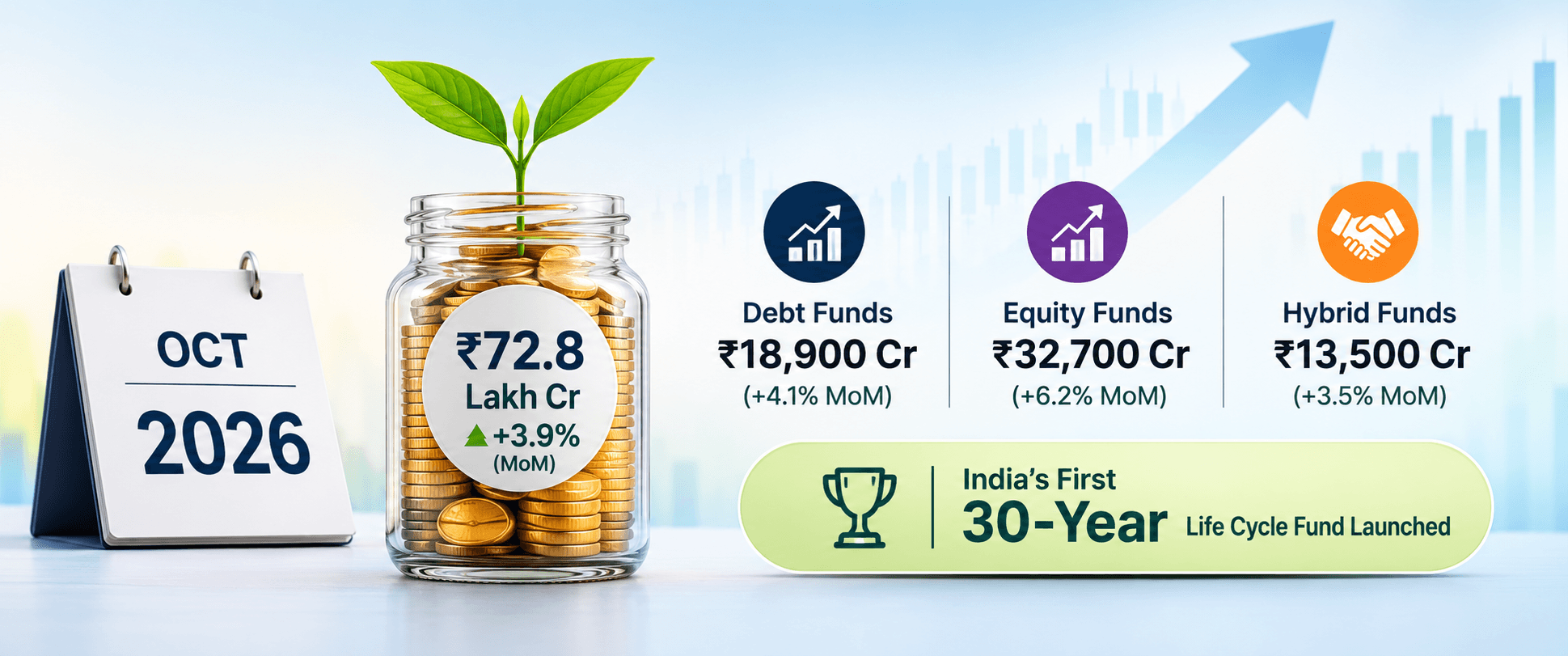
Indian mutual fund industry ended Oct 2026 with assets of Rs 83.38 lakh crs compared to Rs 82.64 lakh crs in Sept 2026.
The Industry witnessed inflows of Rs 1.73 (-1.33) lakh crs, with debt schemes seeing inflows of Rs 1.13 (-1.83) lakh crs compared to outflows last month and equity schemes showing net positive inflows of Rs 32,994 (38,307) crs. Hybrid schemes saw inflows of Rs 3,514 (-457) crs. Equity schemes saw a decrease in assets to Rs 37.14 (37.54) lakh crs. This was mainly due to decline in the markets across the board. Nifty 500 was down 0.75% (-5.85%) though Nifty 50 was up by 1.95% (6.03%) with mid caps down by 3.69% (-7.07%) and small caps down by 5.78% (-3.08%). One year returns for all indices are negative.
Mutual Fund Industry Overview
 Monthly flow and AUM trends:
Equity Mutual Funds :
Net flows in equity schemes have been hovering around the 30,000 crs number for a few months now. Depending on the market performance, the number either goes up or down. Inflows in large and mid cap funds doubled to 8,484 crs whereas flows in mid and small cap schemes were lower. Investors are experiencing the volatility of small and mid cap stocks affecting their flows.
Net inflows in various categories were as under:
- Large & Mid Cap Funds : Rs 8,484 (4,271) crs
- Sectoral/Thematic Funds: Rs 1,714 (3,640) crs
- Flexi-Cap Funds: Rs 4,980 (6,702) crs
- Small-Cap Funds: Rs 6,407 (9,039) crs
- Mid-Cap Funds: Rs 4,893 (7,835) crs
 #EquityFunds #MutualFunds #WealthCreation #LongTermInvestment #EquityMarket #ELSSschemes #Equityschemes
Debt Funds: Inflows to mark the beginning of a quarter.
 Key Trends in Debt Funds:
Total debt fund AUM increased to Rs 18.81 (17.64) lakh crs mainly due to positive flows in liquid and overnight funds due to the beginning of a new quarter.
Most debt scheme categories other than money market funds saw outflows.
#DebtFunds #InterestRates #BondMarket #FixedIncome #FinancialPlanning
Hybrid Funds:
Arbitrage funds also saw net inflows in October. This was a complete reversal of the position last month. Hybrid funds’ assets were at Rs 11.49 (11.52) lakh crs. Net inflows in hybrid funds stood at Rs 3,514 (-457) crs, led by Arbitrage and Multi Asset funds. Equity Savings funds saw outflows. Maybe a rise in interest rates and fall in equities could have resulted in lower returns leading to outflows.
The first 30 year life cycle fund was launched. It collected Rs 86 crs. Approx 35,000 investors have invested close to Rs 250 crs in these funds. As mentioned earlier, these are appropriate for DIY customers who want to invest for a fixed duration and do not want to bother with changing their asset allocation.
#HybridFunds #Diversification #RiskManagement #BalancedInvestment
Passive mutual funds:
AUM of Index funds increased to Rs 3.22 (3.20) lakh crs. Debt index funds again saw net outflows in the month. Equity index funds saw net inflows of Rs 2,649 (2,393) crs.
Exchange Traded Funds (ETFs):
Silver inflows were up at Rs 3,092 (1,974) crs though assets of Silver ETFs were massively down by 14% to Rs 70,221 crs. Gold ETFs inflows were at Rs 3,474 (4,451) crs. AUM of Gold ETFs was down by 3.94% to Rs 1.79 lakh crs.
Fund of Funds Schemes (FoFs):
FoFs collected almost Rs 539 (2,362) crs of net inflows which was a significant decrease over the previous month. This may be due to the closure of Gold FoFs for further subscriptions..
Specialised Investment Funds (SIFs):
Three new SIFs were launched in October and they collected Rs 679 crs. Thirty seven SIFs now manage close to Rs 42,000 crs. More than 175,000 accounts have been created in SIFs. Hybrid SIFs still constitute a significant portion of the total AUM. However, as the category grows, it is likely that equity long short funds will hold a majority of the assets.
Systematic Investment Plans (SIPs):
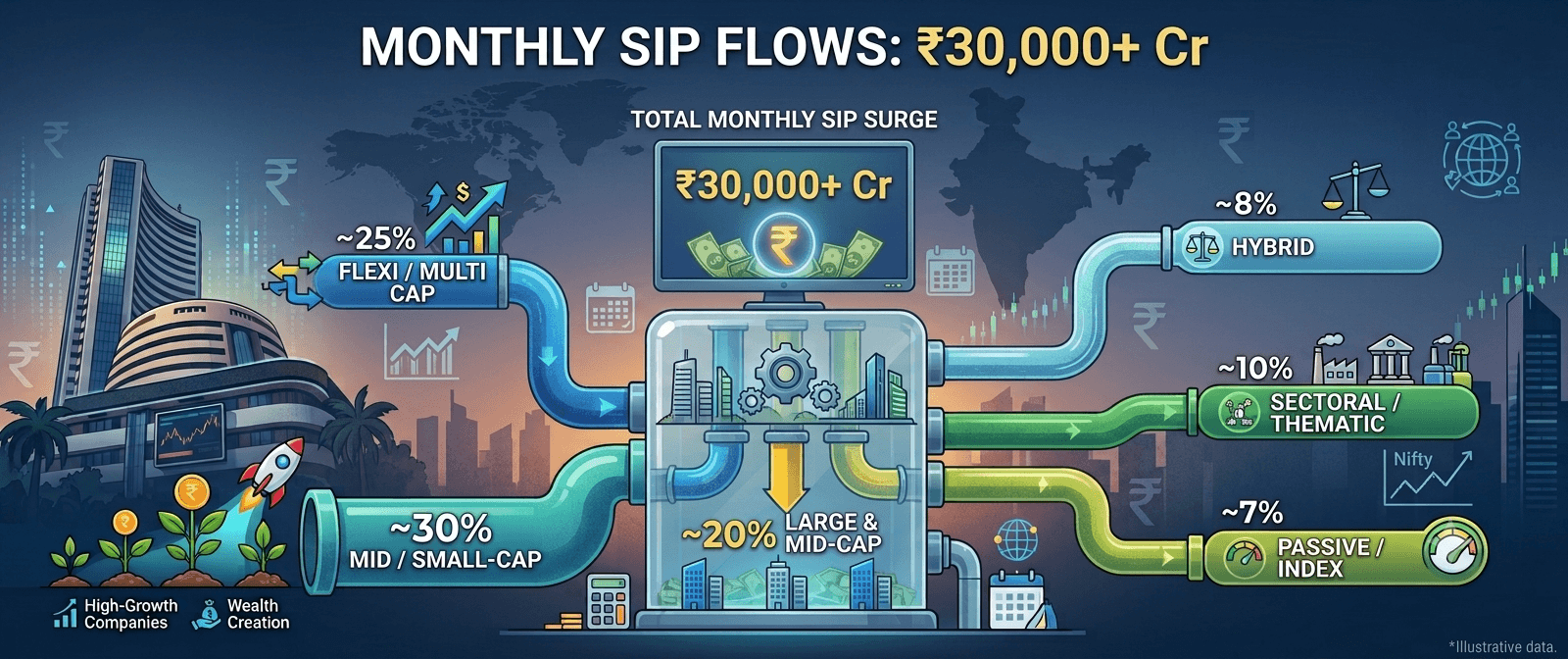
The count of SIPs as well as the inflows fell in October 2026 compared to the previous month. SIP count fell to 10 crs from 10.6 crs and flows fell to Rs 32,160 crs from Rs 32,490 crs. While this is not alarming, one can hope that its a glitch rather than a harbinger of further deterioration in numbers.
 Way forward
As we write this blog, markets have bounced back sharply. They are still below their all time highs that were achieved in Sept 2024 which means markets have not given any returns for two years. This is why equities are considered risky as the returns are not expected to be the same every year and they can swing either way. Investors have been discontinuing their SIPs. However, if this is due to poor returns then the whole advantage of buying low and selling high is lost leading to poor long term returns. Investor psychology plays a huge role in the returns that you earn. If you buy high and sell low, you are unlikely to make any returns and the right thing to do is stay invested in equities for the long term.
About EquiZen
EquiZen, a registered mutual fund, SIF (ARN-272487 – Sanjay Parikh) and PMS distributor (APRN-00158), offers financial solutions with a focus on safety and transparency. We aim to assist you recommending appropriate products based on your time horizon and risk profile. Learn more at www.equizen.in or contact us via +91 9820605203 or sanjay@equizen.in.